
Bay Area Tree Specialists in San Jose, CA, Breaks Down What Quality Tree Care Looks Like in the South Bay
The Questions Worth Asking Before You Hire Anyone to Touch Your Trees
San Jose is a city of neighborhoods — and each one tells its own story through its trees. Willow Glen’s canopy of mature street trees. Almaden Valley’s hillside oaks. Evergreen’s newer developments, where trees are still establishing. The Los Gatos Creek Trail’s riparian corridor winding through it all. The South Bay has an enormous variety of trees, growing in an equally wide variety of conditions, and caring for them well requires more than a truck and a crew.
Bay Area Tree Specialists has worked throughout San Jose and the surrounding South Bay long enough to understand what this landscape actually demands. Here’s what we’ve learned — about this region, about trees, and about what it means to do this work the right way.
San Jose’s Trees Grow in a Complicated Environment
The South Bay presents conditions that shape tree health in ways that aren’t always obvious from the outside. San Jose sits at the convergence of several distinct micro-climates — warmer and drier than the coast, more variable than the Central Valley, and subject to seasonal swings that put trees through a real range of stress:
-
Long, hot, dry summers push trees into drought stress, especially those not adapted to California’s natural dry season or those being watered on schedules designed for lawns rather than trees.
-
Winter rain arrives in concentrated bursts after months of dry conditions — a cycle that stresses root systems and can expose hidden structural weaknesses when the ground softens.
-
Valley heat accumulation bakes trees that were planted with Bay Area coastal conditions in mind, not South Bay inland temperatures.
-
Urban soil compaction throughout established neighborhoods limits root expansion, drainage, and the biological activity that supports genuine tree health.
-
The region’s history of development means many mature trees have had their root zones disrupted, graded over, or built around — sometimes decades ago — in ways that are only now showing up in how the trees look and perform.
A tree service company that understands these dynamics brings something qualitatively different to your property than one applying generic best practices to a context that isn’t generic.
Every Recommendation Starts With Actually Looking at the Tree
It sounds obvious. It shouldn’t need to be said. But one of the most common complaints we hear from homeowners who’ve had poor experiences with other companies is that recommendations came fast — without a real assessment, without time spent actually evaluating the tree, and without a clear explanation of why.
We don’t work that way. Before any recommendation is made, we look at the tree — not just its visible canopy, but everything that tells the story of its actual condition:
-
Growth patterns and canopy distribution that indicate how the tree has responded to its environment over time.
-
Trunk and bark condition, including any signs of cracking, cankers, or areas where the bark tells a different story than the foliage.
-
The root flare and surrounding soil for evidence of decay, girdling roots, or past disturbance.
-
Branch structure and attachment — particularly in mature trees where co-dominant stems and included bark are common and consequential.
-
The full site context: utilities, structures, drainage patterns, and how the tree’s future growth interacts with its surroundings.
That assessment shapes everything that follows. It’s also what allows us to give you a recommendation we can actually stand behind — because it’s grounded in what we observed, not what seemed most efficient to propose.
Tree Pruning and the Long Game
Ask most homeowners what they want from a pruning job, and the answer is usually about appearance — clean it up, thin it out, keep it off the roof. Those are legitimate goals. But they’re the beginning of the conversation, not the whole thing.
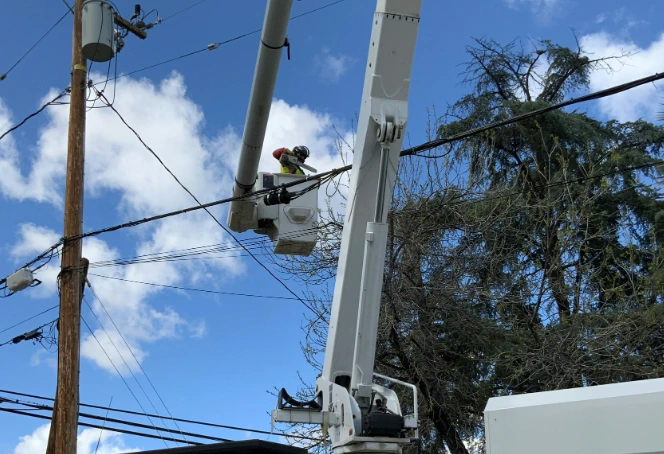
Well-done tree pruning serves the tree’s long-term structural integrity, not just its short-term appearance. And in San Jose, where oak trees, eucalyptus, and large ornamentals are common, the structural decisions made during a pruning visit have consequences that play out over years and decades.
What good pruning looks like in practice:
-
Removing deadwood and crossing limbs that create friction, damage bark, and open pathways for tree disease.
-
Addressing weight distribution in the canopy to reduce leverage on major limbs during wind events.
-
Making cuts that heal cleanly — at the right location, the right angle, leaving the branch collar intact so the tree can compartmentalize the wound.
-
Knowing how much canopy removal a given species can tolerate without triggering stress responses that create new problems.
-
Timing pruning appropriately for the species — some trees in the Bay Area are best pruned outside of certain seasons to minimize disease and pest risk.
Tree trimming that doesn’t account for these factors might look fine the day the crew leaves. Over time, it often creates structural problems that the next company gets called in to address.
Recognizing Tree Disease Before It Gains Ground
San Jose’s climate — warm, dry summers and wet winters — creates conditions where certain tree diseases cycle predictably with the seasons. Others move more opportunistically, establishing themselves in trees already weakened by drought stress, root disturbance, or poor pruning. Either way, the trees most at risk are the ones that aren’t being watched.
Tree disease rarely announces itself dramatically at first. It shows up in small ways: a patch of foliage that’s slightly off-color, dieback at the tips of a branch cluster, a subtle change in the texture or appearance of bark. By the time a tree is visibly struggling — dropping leaves out of season, showing significant canopy decline, developing obvious fungal growth — the disease has usually been present and progressing for some time.
Our approach to tree health care is built around catching issues at an earlier stage. We look for:
-
Early indicators of fungal infection, particularly in oaks and other species common to the South Bay.
-
Pest activity that compounds stress — borers, scale insects, and other pests that target weakened trees.
-
Environmental stressors that lower a tree’s natural defenses and make it more susceptible to disease in the first place.
-
Root zone conditions that are silently limiting tree health, even when the canopy still looks acceptable.
Plant health care at this level isn’t about treating symptoms. It’s about understanding the full system — soil, roots, structure, environment — and intervening at the point where it actually makes a difference.
Tree Risk Assessment: Clear Answers for High-Stakes Questions
When a large tree sits near your home, your driveway, a fence line, or a space where your family spends time, the question of whether it’s safe isn’t abstract. It’s one of the most practical questions a property owner can ask — and it deserves a real answer, not a shrug or an automatic recommendation for removal.
A proper tree risk assessment is structured, documented, and based on what we actually find — not on what’s quickest to recommend. We evaluate:
-
The likelihood of failure: what structural conditions exist, how significant are they, and what would it take to trigger a failure event?
-
The consequences of failure: what’s in the path, how frequently is that area occupied, and what’s the realistic exposure?
-
The options for mitigation: can pruning, cabling, or other interventions meaningfully reduce risk, or has the tree reached a point where those options no longer change the equation?
The output of a good tree risk assessment is clarity. You understand what you have, what the realistic risk profile looks like, and what the options are — so you can make a decision that’s informed by facts rather than anxiety or assumption.
Tree Removal: The Decision That Deserves the Most Care
Because tree removal is permanent, it’s the recommendation that should come with the most explanation and the least pressure. We approach it that way.
Removal is the right answer when a tree represents a genuine, unmitigable risk — when disease or decay has advanced beyond what intervention can address, when structure has failed to the point where no pruning approach changes the risk profile, or when a tree is simply incompatible with its site in ways that create ongoing, unavoidable problems.
It’s not the right answer because removal is faster, easier to quote, or more profitable than a nuanced treatment plan. We’ve turned down removal jobs because the tree didn’t warrant it. We’ll do that again.
When we do recommend removal, we explain exactly what we found and why we believe it’s the appropriate path. When we don’t, we tell you that clearly — and we give you a realistic picture of what ongoing care looks like instead.
What We Think a Great Tree Service Company Owes You
We work in an industry where the barrier to entry is low, and the range of quality is wide. Here’s the standard we think every customer deserves — and that we hold ourselves to:
-
A real arborist is involved in your assessment. Not just the crew lead who shows up with a saw — someone with the training to evaluate what’s actually happening with your tree and explain it.
-
Recommendations with reasoning. You should never walk away from a conversation with us wondering why we suggested what we suggested. We explain our thinking, and we welcome questions.
-
Work that improves what it touches. Every pruning visit, every health care treatment, every removal should leave the tree — or the property — in a genuinely better position than before.
-
Responsiveness when it matters. Storm damage, a suddenly concerning lean, something that changed overnight — these situations deserve a prompt response, not a wait.
-
A long view of your landscape. The best tree care isn’t reactive. It’s a relationship between a property and a team that knows its trees, tracks changes over time, and helps owners make good decisions before problems become crises.
Serving San Jose and the South Bay
Bay Area Tree Specialists serves homeowners, property managers, and businesses throughout San Jose and the surrounding South Bay communities. Whether you’re dealing with a specific tree concern, looking for routine tree pruning and maintenance, preparing for the dry season, or simply want a professional assessment of trees you’ve never had properly evaluated, we’re here to help.
Great tree care starts with a straight conversation. We’re ready to have it.