


Most tree problems don’t start in the canopy. They start at the base—right where the trunk meets the soil.
One of the most important (and most overlooked) ways to protect a tree’s health is to keep the root flare and the soil initiation zone around it free of added soil and plants.
What is the root flare?
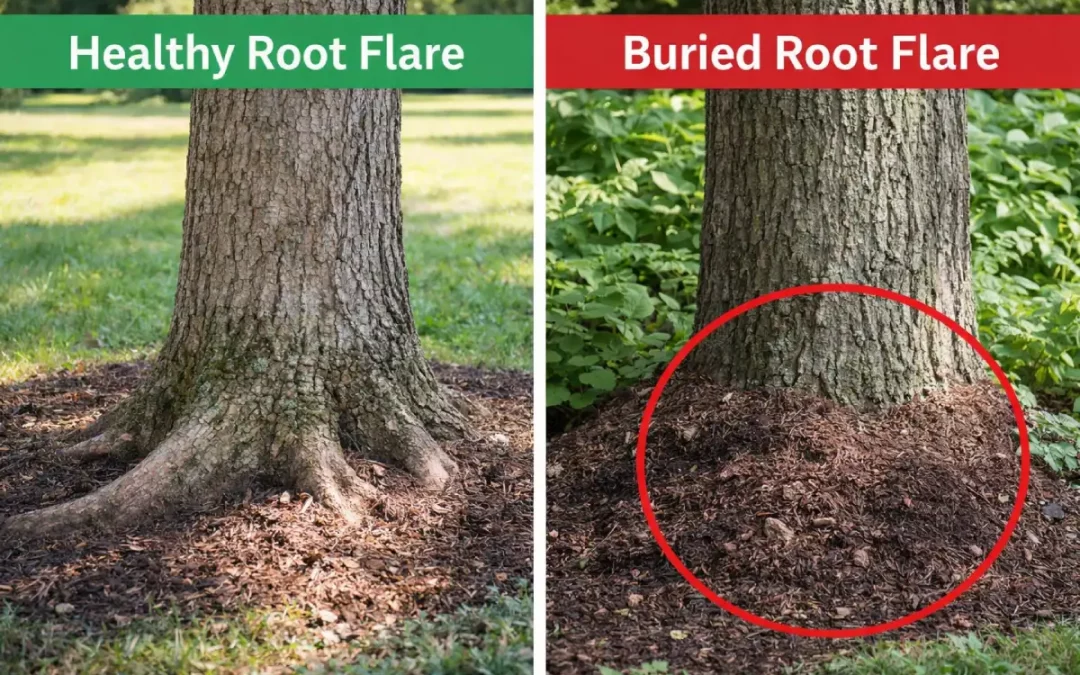
The root flare is the part of the trunk that widens at the base before it transitions into the main structural roots. In a healthy, naturally growing tree, you can usually see the trunk “flare out” slightly as it meets the ground. The tree shouldn’t look like a straight pole going into the dirt.
That flare area is a critical boundary: the trunk tissue is designed to live in air, while the root tissue is designed to live in soil. When we bury trunk tissue, we create the wrong environment in the worst possible place.
What is the soil initiation zone?
The soil initiation zone is the immediate area where the root flare contacts the soil surface in a normal, healthy grade. In many landscapes, the root flare naturally sits slightly above the surrounding soil—often about 1–3 inches higher than the grade.
This zone is where the tree “breathes” and where the foundation of the tree’s stability and long-term health is established.
The common mistake: burying the flare
Trees often decline after the base is covered by:
- Added soil (raised planter beds, grade changes, top-dressing)
- Mulch piled high against the trunk (“mulch volcano”)
- Shrubs or groundcover planted right up to the trunk, usually with extra soil and frequent watering
It may look neat and landscaped, but it creates a constant wet, low-oxygen environment around tissue that is not meant to stay wet.
Why covering the flare harms trees
When the root flare is buried, several things can happen over time:
- Decay and disease risk increases
Moisture trapped against the trunk encourages breakdown of bark and creates favorable conditions for decay organisms. - Roots can become oxygen-starved
Roots need oxygen in the soil. When extra soil or mulch is piled too high, airflow decreases and the tree becomes stressed. Stress shows up slowly—sometimes years later. - Girdling roots become more likely
Buried flare zones can trigger abnormal root growth close to the trunk. Some of these roots circle and tighten around the trunk over time, restricting water and nutrient movement—like a slow constricting belt. - Tree decline and failure risk rise
Trees may thin out, lose vigor, and become more susceptible to pests. In advanced cases, root collar decay can weaken the base and increase the risk of failure in storms.
What homeowners should do
- Make sure the root flare is visible. You should see the trunk widen slightly before it goes into the ground.
- Keep mulch 2–4 inches deep and pull it back from the trunk, so the mulch does not touch the bark.
- Avoid planting shrubs or groundcover right against the trunk. Keep a simple mulch ring instead.
- Avoid adding soil around the base of established trees. If you need to re-grade, talk to an arborist first.
Quick test
If your tree looks like a straight post entering the soil with no flare showing, or if mulch/soil is touching the trunk, it’s worth addressing now—before decline becomes irreversible.